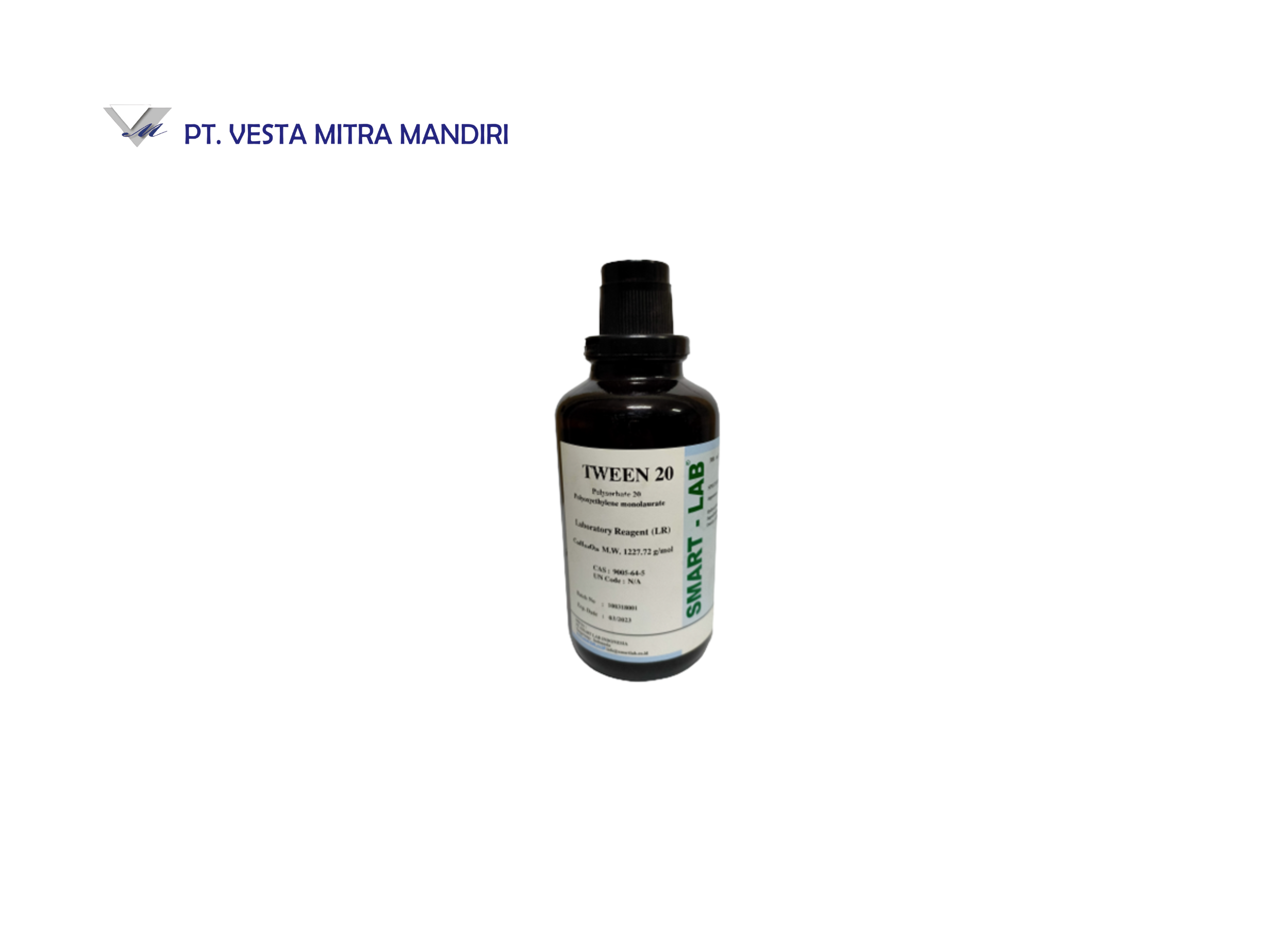
Tween 20 A-1102 is an Analytical Reagent (AR Grade) supplied by PT. Smart Lab Indonesia. It appears as a clear, yellow to amber-colored viscous oily liquid. Chemically, it is a polyoxyethylene sorbitol ester that functions as an effective wetting agent and solubilizer.
Due to its non-ionic nature, Tween 20 carries no net charge and is significantly milder than ionic detergents, making it particularly suitable for applications that require preservation of enzyme activity, protein structure, and antibody binding properties.
Main Features
- Effective Blocking Agent
Commonly used in immunoassays such as Western blotting, ELISA, and immunohistochemistry (IHC) at low concentrations (typically 0.05%) to prevent non-specific antibody binding and reduce background signal.
- Mild Cell Lysis and Permeabilization
Enables gentle disruption of mammalian cell membranes for protein extraction without harsh denaturation or loss of biological activity.
- Emulsifying and Solubilizing Properties
Facilitates the formation of stable oil-in-water emulsions and aids in solubilizing membrane-associated proteins during protein complex isolation.
- Surface Tension Reduction
Improves reagent spreading over membranes, slides, and assay surfaces, ensuring uniform washing, staining, and reagent distribution in both manual and automated workflows.
- High Chemical Stability
Stable in commonly used buffer systems such as PBS and TBS, and remains effective across a broad pH range typical of biological and biochemical research.
- Molecular Biology Grade Suitability
Manufactured to meet stringent purity requirements, minimizing contaminants that could interfere with DNA/RNA extraction, PCR, or other sensitive molecular biology applications.